|
...and don't forget to email your
questions or comments! |
INTRODUCTORY NOTE: As I update this article in March
of 1999, there's been some concern in the press over layoffs at the Robert Mondavi winery.
Folks are anxious that Mondavi not abandon its traditional pursuit of excellence in the
interest of boosting its stock-price. There's also some question whether management is
biting off more than it can chew in its foreign ventures.
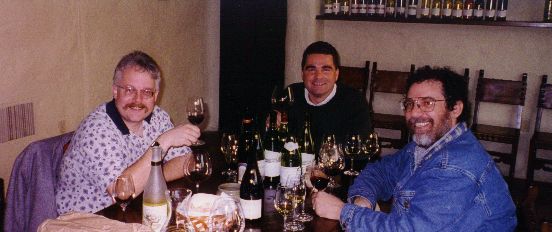
Center: Dyson Demara, Mondavi Trade Relations. To the left and right, fellow intrepid wine bozos Jim Daugherty and Stuart Yaniger. (February 23, 1998) Count on Gallo to do what’s good for Gallo -- but count on Mondavi to do what’s good for wine. It’s not a new observation, but my visit to the Oakville winery last week left me feeling that it’s still as true as ever. Consider our host at Mondavi. Dyson DeMara’s title is "Trade Relations and Education," but he’s no garden-variety flack. A former grower, he speaks with both learning and passion about viticulture. He was frank about Napa Valley’s problems and full of news about what’s being done to address them. He mentioned, of course, that "no one spends more on R&D than Mondavi," but hey, isn’t that right? Dyson showed us print-outs from Mondavi’s site-mapping project, which uses Landsat data from NASA. Bordeaux growers had more than 500 years to figure out what should grow where. The object here is to compress the learning curve into a generation. We looked at a map where much of Napa Valley was color-coded according to vigor. For example, a gravelly bench land might be "low vigor"...a valley floor site with rich soil might be "high vigor"...and there’s also a medium-vigor classification. Why bother? Well, for one thing, it helps you figure out yields. They learned this the hard way at Opus, he said. This is a fairly high vigor site, planted closely, as in Bordeaux. In 1992, they green-harvested here to get yields down to 2-3 tons per acre. But the resulting wine was more vegetal than before. Raising the yields on this particular site actually gave better results. Dispute this if you like, but the ‘92 Opus is indeed somewhat herbal, and it’s hardly self-serving for someone at Mondavi to admit this. The ‘94 Mondavi Reserve Cabernet Sauvignon, he told us, came from sites with varying yields -- as high as 10 per acre and as low as 2. Again, you can argue the theory, but, as we found later on, it’s hard to argue with the results. Mondavi has been mapping phylloxera spread for the past 12 years. And here’s a sobering fact -- 39% of the AXR stock in Napa Valley is still in the ground. Lots has been printed about all the new plantings happening everywhere, but many growers simply can’t afford to do it. This says to me that more vineyards will be changing hands in the years to come, and the big, well-heeled firms are the obvious beneficiaries. What about Pierce’s Disease? How big is the problem? Very big, said Dyson. So far, no one has a solution, but they’re beginning to understand the enemy a little better. One theory is that the insect which spreads Pierce’s -- the blue-green sharpshooter -- tends to favor vines that are being "pushed." So for this reason alone, big yields on young vines are not a good idea. Close-planted sites like those at Opus also seem to be more vulnerable, simply because it’s that much easier for the disease to spread. They’re encouraging growers to rid sites of succulent, non-indigenous plants that tend to attract the pest. And there’s research going on as to the best ways to "insulate" vineyards from the creek-beds where the sharpshooters like to live. After an hour or so of geek-talk we tasted some wines -- all nice, with a couple of absolute stunners.
Top of page Back to articles contents page
|